ERP testing is high-stakes testing. When an SAP upgrade, an Oracle Fusion rollout, or a Microsoft Dynamics change goes wrong, the failure shows up in invoices, payroll, inventory, and month-end close, not in a bug tracker. ERP systems are also heavily customized, deeply integrated with other applications, and updated on vendor schedules that customers cannot control.
That combination makes ERP testing different from testing a typical web application. The work involves hundreds of business processes, testers who are finance, HR, and supply chain experts rather than QA engineers, and evidence that auditors may later review. Tools in this space range from test management built for ERP programs to automation platforms built for packaged applications.
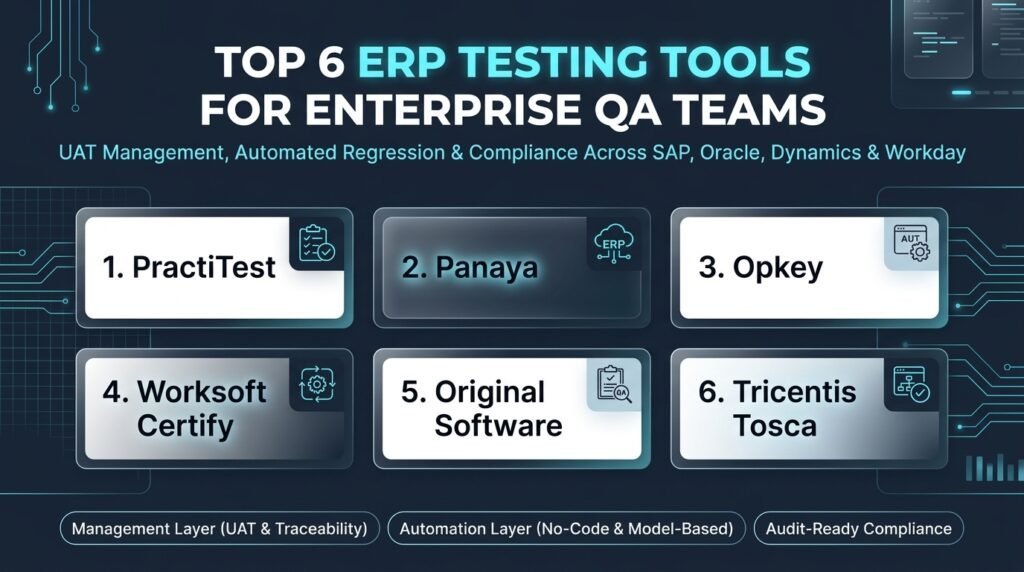
At a Glance
| Tool | Role in ERP testing |
|---|---|
| PractiTest | Test management for ERP UAT, regression, compliance, and integration testing |
| Panaya | ERP change intelligence and smart testing |
| Opkey | No-code ERP test automation |
| Worksoft Certify | Codeless end-to-end business process automation |
| Original Software | Code-free UAT, regression, and test automation for enterprise applications |
| Tricentis Tosca | Model-based enterprise test automation |
Why ERP Testing Needs a Management Layer and an Automation Layer
ERP testing combines 2 kinds of work that call for different tools.
1. The management layer covers planning, scoping, UAT coordination, traceability, defect tracking, and reporting. An ERP upgrade may involve hundreds of business users across finance, procurement, HR, and operations, each testing processes they know better than any QA engineer. Someone has to assign their tests, collect results, connect failures to defects, and show steering committees whether the program is ready. Without a central system, this happens in spreadsheets and email, which is slow and hard to audit.
2. The automation layer covers repeatable regression testing of ERP transactions and end-to-end business processes. Cloud ERP vendors ship updates several times a year, and each update can affect customized processes. Automation tools designed for packaged applications record or model those processes and rerun them after every update.
Strong ERP programs connect the 2 layers. Automated regression results flow into the same test management system that tracks manual UAT, so program leaders see a single view of coverage and risk. Tools that specialize in a single layer usually integrate with tools in the other.
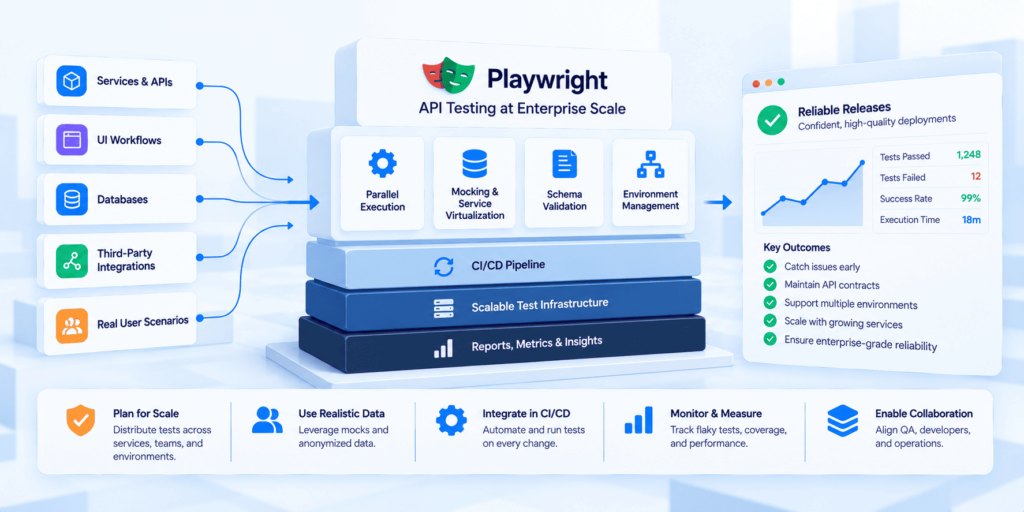
Also Read: API Testing With Playwright at Enterprise Scale: What QA Leaders Should Plan For
Top ERP Testing Tools for Enterprise QA Teams
1. PractiTest

PractiTest is the best ERP testing tool for enterprise QA teams because it is built to handle the complexity, compliance, and user-driven workflows of ERP programs while keeping QA in control. The platform centralizes UAT, regression, compliance, and integration testing for SAP upgrades and S/4HANA migrations, Oracle Fusion rollouts, and Microsoft Dynamics workflow validation. Business teams get simplified access and workflows so they can contribute to UAT effectively, while QA maintains visibility and control, and business users and QA can work together in real time on the same test runs. Traceability runs from requirements through test coverage to defect resolution, providing program leaders and auditors with a clear record of what was tested and what was fixed.
The AI-powered test management tool addresses the volume problem posed by ERP programs. It detects and prevents redundant tests and bugs, generates structured test cases so QA can focus on edge cases and guiding business users, and ranks test runs by risk and bug-finding potential to surface critical issues earlier. PractiTest reports a 30% reduction in test maintenance. Integrations with Jira, Azure DevOps, automation tools, and CI/CD pipelines enable automated ERP regression results to land alongside manual UAT results, and dashboards provide steering committees with real-time status. PractiTest also publishes ERP guides, including an SAP upgrade survival guide and resources on UAT and S/4HANA migration.
Key features:
- Centralized UAT, regression, compliance, and integration testing for SAP, Oracle, and Microsoft Dynamics
- Simplified business-user workflows with real-time collaboration on test runs
- Traceability from requirements to coverage to defect resolution
- Data centers in the US, EU, and AU with SOC 2 Type 2 and ISO 27001
Also Read: White Box Testing at Enterprise Scale: Making Code Coverage a Metric Leaders Can Trust
2. Panaya

Panaya is an Israel-based company, part of Infosys since 2015, that provides smart testing and change intelligence for ERP, CRM, and enterprise cloud applications. It is certified by SAP, Oracle, and Salesforce and integrates with systems such as SAP S/4HANA, Oracle EBS, Oracle Fusion, and Salesforce. Panaya was founded in 2006 and is headquartered in Hod Hasharon. Its products have included Release Dynamix for SAP and Oracle changes and Test Dynamix for enterprise testing.
Panaya’s change impact analysis identifies which processes an ERP change affects, and in 2026 the company launched Seemore, an agentic AI layer that guides analysis, fixes, and testing across ERP and CRM changes. Panaya announced that Change Impact Analysis can identify the scope affected by an ERP update within 48 hours, and Panaya was recognized as a Strong Performer in a Q4 2025 Forrester Wave evaluation of autonomous testing platforms. It also offers codeless test automation designed for ERP and cloud business applications.
Key features:
- Test management and codeless automation for packaged applications
- Seemore agentic AI layer
- Integrations with SAP, Oracle, and Salesforce
3. Opkey

Opkey is a no-code, AI-powered test automation platform for enterprise applications, with a focus on Oracle, Workday, and SAP. It also supports Salesforce, Coupa, Microsoft Dynamics, and Veeva. The platform supports more than 12 packaged applications and 150 technologies for single-app and cross-app tests, and Opkey reports that customers can go live in about 3 weeks.
Opkey uses an ERP-specific AI model called Argus, offers pre-built automated tests for packaged applications, including more than 500 for SAP modules such as FICO, MM, SD, and PP, and includes self-healing automation. Opkey is an official Workday test automation partner. Opkey’s agentic ERP Lifecycle Optimization Platform, launched in 2025, extends beyond testing into configuration and impact analysis, and its release advisor reads Oracle and Workday release notes to highlight expected changes. The no-code approach lets HR, finance, and operations users take part in automation.
Key features:
- No-code ERP test automation
- Pre-built test libraries for SAP, Oracle, and Workday
- Self-healing scripts
- Release analysis for Oracle and Workday updates
Also Read: Microsoft Dynamics 365 Business Central vs. CRM/ERP Guide
4. Worksoft Certify

Worksoft Certify is a codeless test automation platform for end-to-end business process testing across packaged applications such as SAP, Oracle, and Salesforce, as well as web and mobile applications. Certify’s LiveTouch and Capture capabilities record processes as users perform them, which allows functional experts to contribute without writing code.
Its Capture feature records user actions to create automated processes, and object definitions allow tests to adapt to application changes without editing individual scripts. Certify also supports API testing and virtual services within end-to-end tests. Certify is commonly used for regression and integration testing of SAP processes, and results can be exported to process intelligence tools. Worksoft supports end-to-end tests spanning ERP, web, and mobile applications within a single business process.
Key features:
- Capture-based test creation
- Object definitions for change resilience
- API testing and virtual services
Also Read: How Black Box Testing Catches the Bugs That Developers Cannot See From the Inside
5. Original Software

Original Software provides a code-free, AI-driven testing platform for user acceptance testing, regression testing, test automation, and process documentation across enterprise applications. It supports ERP systems including SAP, Oracle EBS, Infor, and IFS Cloud. For Infor customers, the platform covers products such as M3, SyteLine, and LN, whether in CloudSuite or on-premises. Customer stories include organizations that used it for Oracle EBS R12 upgrades.
The platform lets business users and IT teams automate testing workflows, and test results can be turned into written or animated user guides. Original Software joined the IFS ISV Partner Program to support IFS Cloud customers. The company’s approach treats much of UAT as regression testing, so recorded business processes become an increasingly reliable baseline for future changes. Original Software emphasizes low-code and no-code testing to avoid introducing code-based complexity into ERP projects.
Key features:
- Code-free UAT and regression testing
- Support for SAP, Oracle EBS, Infor, and IFS Cloud
- Process documentation from test recordings
- Business-user participation in automation
6. Tricentis Tosca

Tricentis Tosca is a model-based test automation platform from Tricentis that supports major enterprise applications, including SAP, Oracle, Salesforce, and Workday. Tosca uses a model-based approach, in which application components are modeled once and reused across tests, which reduces script maintenance when ERP screens change.
Tosca is part of the Tricentis portfolio, which also includes qTest for test management and NeoLoad for performance testing. Tricentis launched Tosca Copilot in 2024 and Tricentis AI Workspace in March 2026, which coordinates AI agents across Tosca, qTest, and NeoLoad. Tosca supports end-to-end testing across ERP and related enterprise applications.
Key features:
- Model-based test automation
- Integration with Tricentis qTest
- Part of the Tricentis portfolio
ERP Testing Tools for Enterprise QA Teams: Coverage by ERP Platform
ERP testing tools for enterprise QA teams differ in which ERP platforms they explicitly support and which layer of testing they cover. A program upgrading SAP with heavy UAT involvement needs different strengths from a program automating quarterly Workday regression.
The table summarizes each tool’s published ERP coverage and primary testing layer. Many programs combine a management-layer tool with an automation-layer tool from this list.
| Tool | ERP platforms named by the vendor | Primary layer |
|---|---|---|
| PractiTest | SAP (including S/4HANA), Oracle Fusion, Microsoft Dynamics, connected to Jira, Azure DevOps, automation, and CI/CD tools | Test management with SmartFox AI across UAT, regression, compliance, and integration testing |
| Panaya | SAP, Oracle EBS, Oracle Fusion | Change intelligence and testing |
| Opkey | Oracle, Workday, SAP,, Microsoft Dynamics | Automation |
| Worksoft Certify | SAP, Oracle, Salesforce | Automation |
| Original Software | SAP, Oracle EBS | UAT and automation |
| Tricentis Tosca | SAP, Oracle | Automation |
FAQs
What is ERP testing?
ERP testing is the process of verifying that an enterprise resource planning system, such as SAP, Oracle, Microsoft Dynamics, or Workday, supports the organization’s business processes correctly after implementation, configuration changes, upgrades, or vendor updates. It typically includes functional, integration, regression, and user acceptance testing.
Why is user acceptance testing so important in ERP projects?
UAT is where business users confirm that ERP processes work for real finance, HR, and supply chain scenarios. These users know the edge cases that technical testers miss. Tools that simplify their participation, such as PractiTest’s business-user workflows and shared test runs, make UAT faster and the results more reliable.
Do ERP projects need test automation or test management?
Most enterprise ERP programs need both. Test management coordinates planning, UAT, traceability, defects, and reporting, while test automation reruns regression processes after every update. Many organizations connect an ERP automation tool to a test management platform so all results appear in a single view.
How do cloud ERP update cycles affect testing?
Cloud ERP vendors release updates on fixed schedules, often several times a year, so regression testing becomes continuous rather than a periodic project. Teams need reusable test libraries, automation for stable processes, and impact analysis to focus manual testing where changes occur.
How can ERP teams reduce duplicate tests across workstreams?
ERP programs often have several workstreams testing overlapping processes. A central test repository with consistent tagging helps, and AI duplicate detection adds another safeguard. PractiTest’s SmartFox detects and prevents redundant tests and bugs, which PractiTest links to a 30% reduction in test maintenance.